


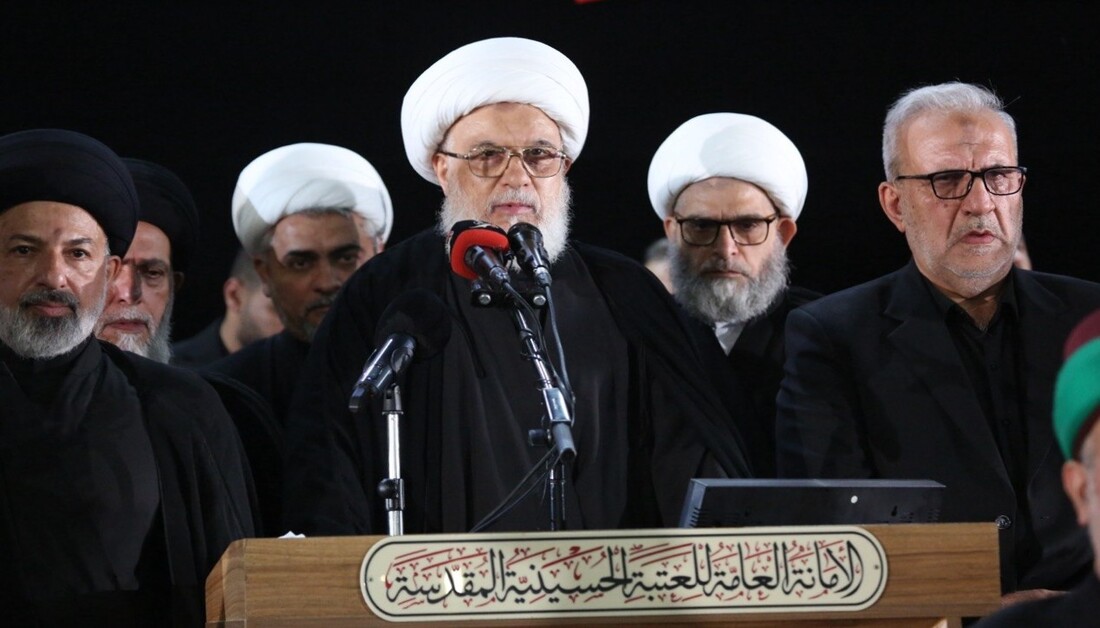
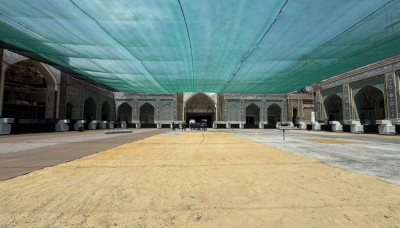
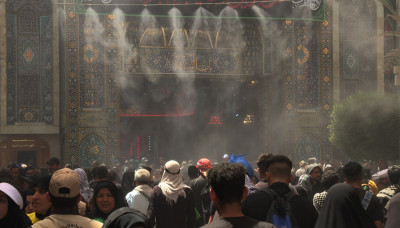
The representative of the Supreme Religious Authority, Sheikh Abdul Mahdi Al-Karbalaei, stated that the Husayni cause is founded on two essential pillars: emotion, grief, and tears, and conscious knowledge. He emphasized the importance of achieving a precise and informed balance between sincere Husayni emotion, expressed through poetry, mourning, lamentation, and gatherings, and conscious understanding of the Husayni cause, its principles, roots, and objectives. His remarks came during a speech delivered at the ceremony marking the replacement of the banner on the dome of Imam Hussein (peace be upon him).
The representative of the Supreme Religious Authority said, "There are two essential pillars in the Husayni cause: emotion, grief, tears, and conscious knowledge. Here we observe how we can achieve a precise and informed balance between sincere Husayni emotion, represented by poetry, crying, lamentation, and mourning gatherings, and conscious understanding of the Husayni cause, its principles, roots, and objectives. Such a balance means giving emotion its due and knowledge its due while combining the two." He explained that "this integration of emotion and knowledge is what enables us to implement the objectives of the Husayni movement."
He explained that "through these two pillars, we can transform both the individual and the nation and turn these practices into a program of reform and change for individuals and society across all aspects of life. Therefore, the School of Ashura is not confined solely to its tragic and emotional dimension, although that dimension remains an important pillar. Rather, it affirms that tears, lamentation, mourning, and gatherings serve as a starting point for awareness, knowledge, strengthening Islamic identity, and building a society in which the principles of the Husayni movement are reflected."
He added that "the most important educational and media tool for raising awareness of the Husayni cause is the Husayni sermons. For this reason, the Supreme Religious Authority has devoted significant attention to it by offering important guidance to preachers, speakers, poets, and reciters in order to achieve the highest objective of the Husayni sermons." He noted that "the first point is a strong emphasis on the Holy Quran within religious discourse, as it is Allah’s message to all creation and the criterion between truth and falsehood, while the path and sacrifices of Ahl al-Bayt (peace be upon them) were an application and fulfillment of its teachings."
He continued, "Religious discourse should include evidence supporting the foundations of the true creed and its firm proofs through accessible and easily understood methods, as well as mention the virtues of the sayings of the Prophet (peace and blessings be upon him and his family) and his progeny, and reference what is found in the sermons of Commander of the Faithful Imam Ali ibn Abi Talib (peace be upon him) in Nahj al-Balagha, including remembrance of Allah Almighty, His signs in creation, and descriptions of the Hereafter." He pointed out that "among the recommendations of the Supreme Religious Authority are the instructions of the Imams (peace be upon them) to their followers and those who love them, so that they may embody their morals. Reviving the ceremonies of Ashura means adopting the character of Imam Hussein (peace be upon him), following his guidance, and adhering to his manners. These recommendations emphasize practical commitment to the teachings of Ahl al-Bayt (peace be upon them), fostering affection and love among one another, and displaying their noble character even toward those who differ in religion and sect."
He stressed "the need to avoid raising issues that provoke division and disagreement among believers and to focus instead on preserving unity, solidarity, and mutual affection."
He also emphasized "avoiding statements made without knowledge and insight, as this is prohibited in religion regardless of the content of the statement."
He further stated that "the preacher should pay attention to this recommendation, and indeed all of us are concerned with it, including all believers, by engaging in self-criticism, never feeling secure from error or wrongdoing, remaining mindful of Allah Almighty’s presence and oversight, benefiting from the criticism of others, and treating them fairly."
He noted that "we must uphold piety and sincerity toward Allah Almighty in speech, conduct, and performance, striving for His pleasure and acceptance, and ensuring that all actions are undertaken solely for the sake of Allah Almighty."






اترك تعليق