


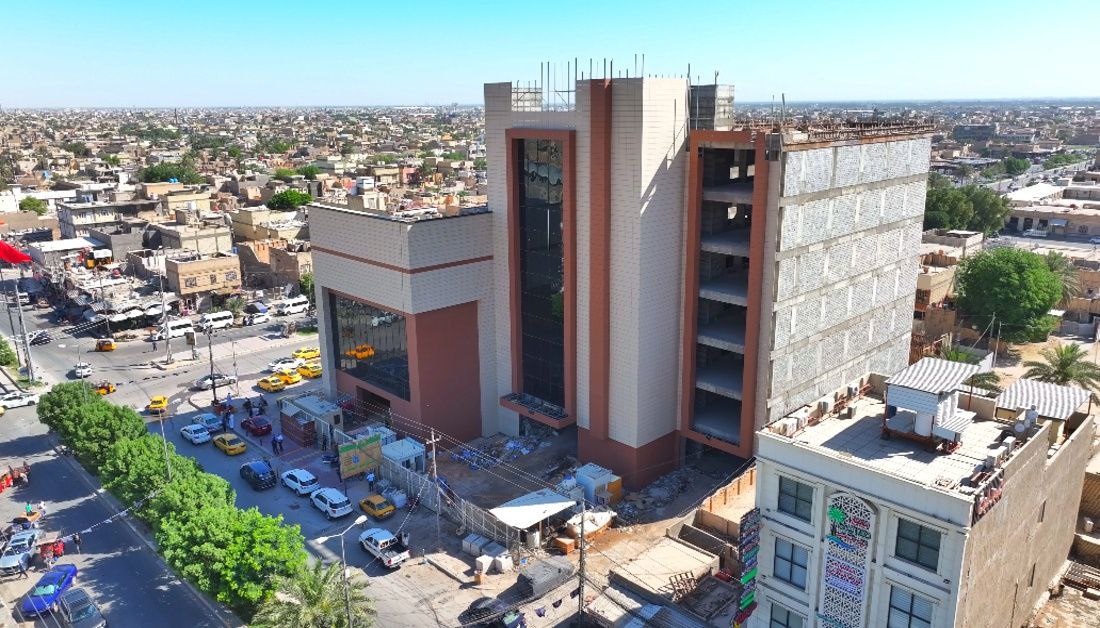
The Engineering and Technical Projects Department of the Imam Hussain Holy Shrine has announced the continuation of work on the Al-Sibt Hospital for Gastrointestinal Diseases and Liver Transplantation, the first facility of its kind in Karbala, confirming that the project has reached advanced completion stages.
Engineer Waseem Kazem, Deputy Head of the Department for Direct Execution Affairs, told the official website that “under direct guidance from the representative of the Supreme Religious Authority, Sheikh Abdul Mahdi Al-Karbalai, the Engineering and Technical Projects Department of the Imam Hussain Holy Shrine continues work on the Al-Sibt Hospital for Gastrointestinal Diseases and Liver Transplantation in Karbala,” noting that “the project has achieved advanced completion rates.”
He explained that “the hospital is being constructed on a land area of 2,500 square meters, with a capacity of 100 beds,” adding that “it is considered one of the first specialized hospitals of its kind in the province, where advanced liver transplant procedures will be performed.”
He added that the project consists of Building (A), with an area of 5,200 square meters across four floors; Building (B), covering 6,300 square meters over nine floors; and Building (C), with an area of approximately 2,800 square meters spanning seven floors.
He further noted that “completion rates have reached 95 percent for Building (A), while Buildings (B) and (C) have each reached 35 percent.”
He pointed out that “the hospital will include key departments such as operating theaters, intensive care units, endoscopy, ultrasound, MRI, and other essential medical sections.”
The Imam Hussain Holy Shrine continues its efforts to provide advanced medical services to citizens through the establishment of multiple hospitals, many of which offer treatment free of charge or at reduced costs. These initiatives aim to ease patients’ suffering and reduce the need to travel abroad for treatment, sparing them the hardships of travel and the risks of fraud.


اترك تعليق