


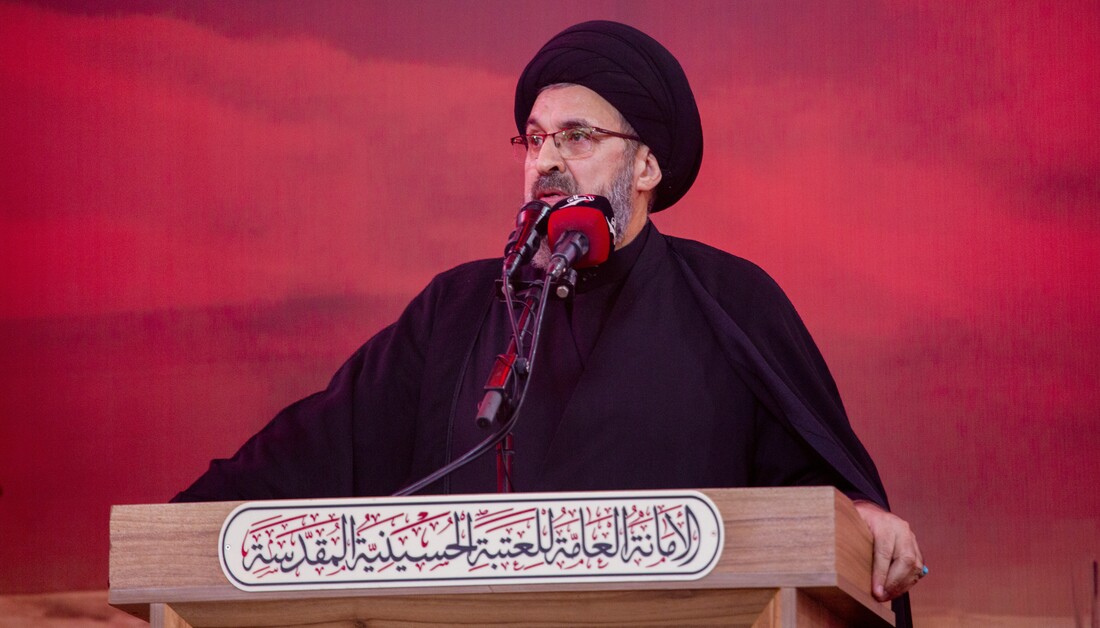
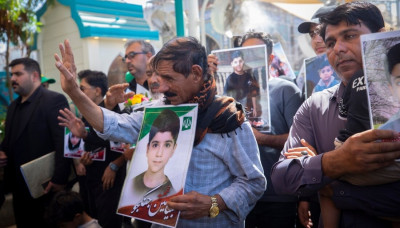
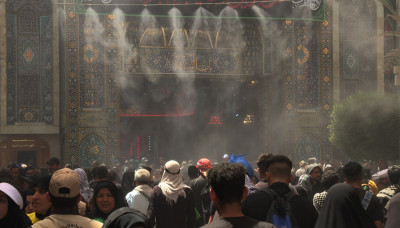
Hawza scholar Sayyid Rashid Al-Husseini affirmed that Ashura represents a school of awareness and insight, stressing that university students are required to strengthen their religious and intellectual identity in order to confront contemporary challenges. He made the remarks during the launch of the Unified Mourning Procession of Iraqi University Students, organized by the Holy Karbala Shrine as part of its mourning programs commemorating the martyrdom of Imam Hussein (peace be upon him). The event witnessed broad participation from Hawza scholars, more than (5000) students from Iraqi universities, as well as a number of university lecturers.
Sayyid Rashid Al-Husseini said, "Ashura is a great season in which the pledge to the Master of Martyrs, Imam Hussein (peace be upon him), is renewed, reviving within the community, the spirit of responsibility, awareness, and insight. It is a season that inspires people in matters related to both their religion and their worldly life."
He explained that "the youth stage is among the most important periods in a person's life, as it possesses the foundations for growth and advancement on both the academic and religious levels. Young people should make the most of this stage by building their character, shaping their future, and giving attention to the Hereafter before it is too late."
He added that "a person's value does not lie in their academic or social status, but rather in the extent of their devotion to Almighty Allah," noting that "worship and self-discipline should be accompanied by awareness and insight, as they form the foundation for strengthening faith and distinguishing between truth and falsehood."
He pointed out that "university students today face major cultural and moral challenges, reflected in information and guidance that may be presented under the guise of religion, humanity, or compassion, while in reality carrying misguidance, violence, and efforts to divide the community ." He stressed "the necessity of dealing wisely with content circulated on social media, particularly material that targets the religious institution, its religious authorities, and its prominent figures."
He continued, "Distinguishing between truth and falsehood requires genuine insight. We cite what took place on the Day of Ashura, where there were two prayers: the prayer of Imam Hussein (peace be upon him) and his companions, and the prayer of Umar ibn Saad and his companions," emphasizing that "the difference between them can only be recognized through awareness and insight."
He went on to say that "the months of Muharram and Safar represent a season for reflection, returning to one's innate nature, and reconnecting with the history of the nation and its Imams (peace be upon them), and that mourning processions and the Arbaeen pilgrimage attended by millions contribute to strengthening individuals and enhancing their awareness."
He affirmed that "Islam encourages the pursuit of knowledge, but its true value is realized only when it is accompanied by righteous deeds and piety," calling on university students to make their classrooms and presence at universities an extension of Hussaini media, and to embody the conduct of the Infallibles (peace be upon them) in their morals, relationships, and behavior.
He also noted that "it is essential for Imam Hussein (peace be upon him) to remain present in the life of every believer throughout the year by adhering to the path of reform, enjoining good, and forbidding evil, and that Hussaini rituals should be reflected in practical conduct in a way that helps safeguard society, particularly young people, against the cultural assault targeting religious identity."
He further pointed out that "reviving Hussaini rituals, including weeping, chest-beating, and participating in mourning processions, should be reflected in building a conscious Hussaini and Zainabi spirit capable of confronting intellectual and cultural challenges, while reinforcing the values of faith and insight within society."



اترك تعليق