


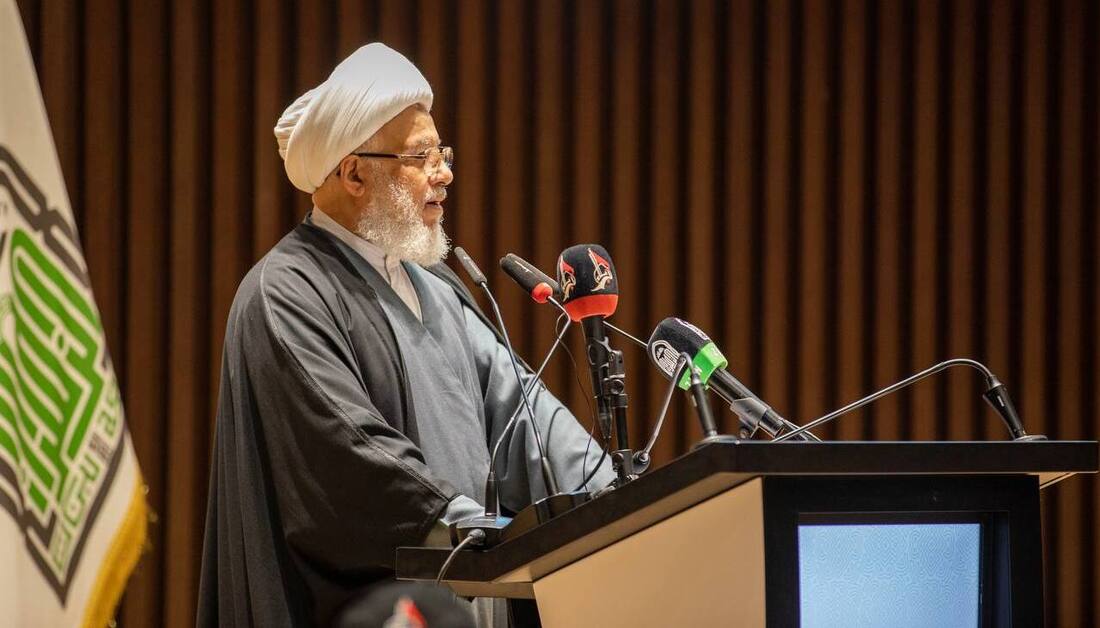
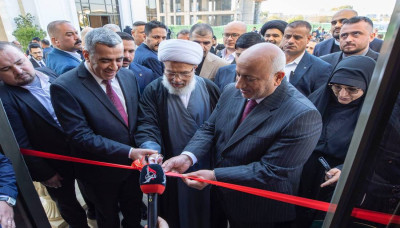
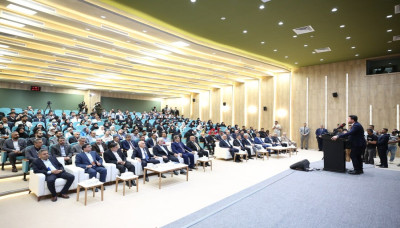
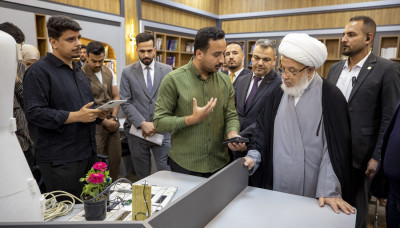
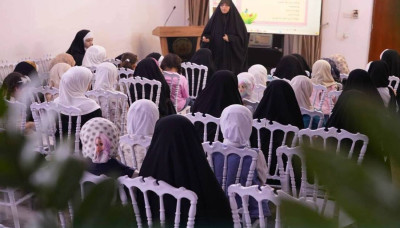
The representative of the Supreme Religious Authority, Sheikh Abdul Mahdi Al-Karbala’i, affirmed that the real challenge does not lie merely in producing a doctor, engineer, or teacher, but in shaping a humane doctor, a humane engineer, and a humane teacher. He emphasized that knowledge carries a profound message and significant human value. These remarks were delivered during his speech at the inauguration of the College of Engineering and Information Technology building at Al-Zahra University for Women, affiliated with the Imam Hussain Holy Shrine.
The representative of the Supreme Religious Authority stated that “university education is not merely a utilitarian or vocational path, but an act of worship and a religious, national, and ethical responsibility.” He stressed that this understanding must be clear and well comprehended by professors and university staff so that it can be implemented in practice and reflected in reality.
He explained that contemporary reality presents two paths and philosophies of university education, both linked to defining the purpose and objective of education. He noted that the movement of human and social life must be based on purposeful goals in their devotional, social, economic, and ethical dimensions.
He added that the first path is the utilitarian, worldly approach, which views university education as a means to obtain a degree, employment, social status, and income. This, he said, may turn universities into factories for producing employees rather than scholars. Despite the scientific competencies this path may produce, it lacks the human and mission-driven dimension, and knowledge under such an approach can become a tool for destruction, the subjugation of peoples, and the shedding of innocent blood.
He clarified that the second path is the mission-oriented, devotional approach, which makes knowledge a means to benefit people, develop the land, achieve human dignity, advance scientific progress, and realize social justice. He noted that education can become a true act of worship through intention, purpose, closeness to God Almighty, and adherence to the path established by God in imparting and disseminating knowledge.
He continued by stating that knowledge, in the Islamic vision, is the criterion of human value and the measure of distinction among people. He emphasized that university education represents a major national responsibility, as it is the advanced stage in building the specialized individual capable of serving society, where the student moves from receiving and memorization to research, analysis, and critical thinking.
He pointed out that the university represents the final station in shaping future generations and the factory of scientific awareness capable of achieving dignity and sovereignty. He stressed the importance of scientific research as a means of creativity and addressing societal problems, rather than merely a tool for publication or academic promotion.
The representative of the Supreme Religious Authority underscored that the relationship between professor and student, in the Islamic perspective, is an educational and nurturing relationship based on respect, affection, and appreciation, not a purely material one. He emphasized the need for integration between specialized sciences, faith, ethics, and human values.
He reiterated that the true challenge is not in producing a doctor, engineer, or teacher alone, but in producing a humane doctor, humane engineer, and humane teacher, affirming that knowledge carries a profound message and great human value.
He went on to state that the Imam Hussain Holy Shrine currently oversees several universities, including Warith Al-Anbiyaa University, Al-Zahra University for Women, Al-Sibtain University for Medical Sciences, in addition to Al-Thaqalayn Technical University, whose implementation will soon begin through an engineering company. He also cited the Smart University, Al-Bayyinah University, the University of Nahj Al-Balagha Sciences, and Imam Hussain University for the Holy Qur’an and Prophetic Hadith. He noted plans to establish additional universities for women, possibly in different governorates, stressing that this expansion is not driven by formal or numerical motives, but is based on a clear vision, a defined mission, and a deep understanding of the philosophy of university education.




اترك تعليق