


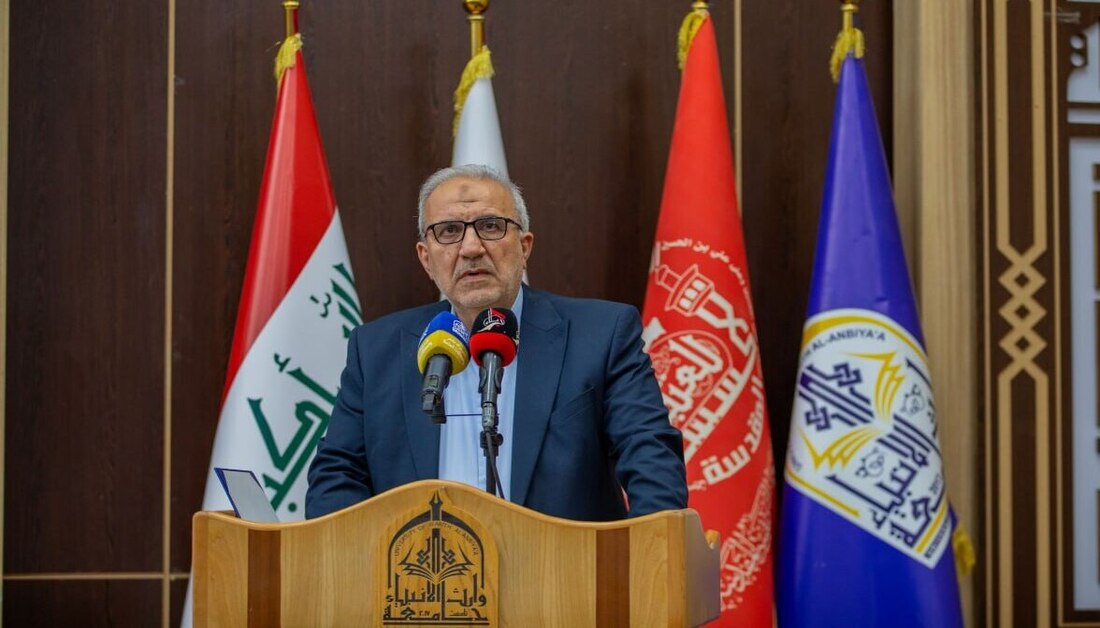
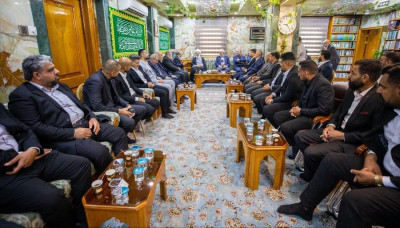
The Secretary-General of the Imam Hussain Holy Shrine, Mr. Hassan Rashid Jawad Al-Abayji, emphasized that developing the Islamic personality in accordance with the Holy Qur’an, the Prophetic Sunnah, and the teachings of Ahlulbayt (peace be upon them), while reinforcing the values of monotheism, constitutes the foundation for building an integrated society. His remarks came during his address at the opening of the Fourth International Scientific Conference on Guidance, held at Warith Al-Anbiyaa University.
Al-Abayji stated that “the sources of Islamic legislation are founded on two essential pillars: the Holy Qur’an and the noble Prophetic Sunnah, in addition to the sayings and sermons of Ahlulbayt (peace be upon them), as found in Nahj al-Balagha, Al-Sahifa al-Sajjadiyya, and Risalat al-Huquq.” He noted that “the Holy Qur’an holds primacy among these sources, as it is a living word valid for every time and place.”
He explained that “the noble Prophetic discourse represents a comprehensive educational framework that addresses all dimensions of human life, material and spiritual, educational, ethical, and social, and that the Prophet Muhammad (peace and blessings be upon him and his family) was the foremost role model and educator of the nation, leading the guidance and educational process in all its psychological, social, and moral dimensions.”
He added that “modern studies have confirmed that the methodology of the Prophet Muhammad (peace and blessings be upon him and his family) includes practical instructions and guidance for confronting life’s challenges, correcting behavior, and developing intellectual, psychological, and social skills. It remains valid for all times and places, and his noble discourse contributes to building a balanced and sound personality, liberating the nation from backwardness and cultural alienation, and confronting cultural invasion and globalization.”
He further stated that “employing this discourse within educational processes and in school and guidance center curricula opens new horizons for applying Islamic educational theory and nurturing a balanced, faithful generation capable of facing modern challenges and building a virtuous society founded on harmony between the material needs of human beings.”
Al-Abayji stressed that “developing the Islamic personality according to the Holy Qur’an, the Prophetic Sunnah, and the teachings of Ahlulbayt (peace be upon them), and reinforcing the values of monotheism, form the basis for establishing a complete society built on justice, equality, freedom, and human integration. The declaration of monotheism is the most significant means of connection between the servant and his Lord, solidifying the Islamic vision in individual and societal life.”
The Fourth International Scientific Conference on Guidance was held under the theme (Guidance Solutions to the Problems of Muslim Women Amid the Challenges of Cultural Invasion) as part of the Imam Hussain Holy Shrine’s efforts to reinforce religious principles and consolidate ethical values derived from the Holy Qur’an and the teachings of Ahlulbayt (peace be upon them), thereby strengthening society intellectually and culturally.




اترك تعليق